Class A licensed · Licence No. 2333881
Emergency Make-Safe
Fire, storm and impact damage do not wait for a scope of works. When a building containing asbestos is damaged, the material is already broken and already moving, and the first job is to stop the site getting worse.
Overview
Stabilise First, Scope Second
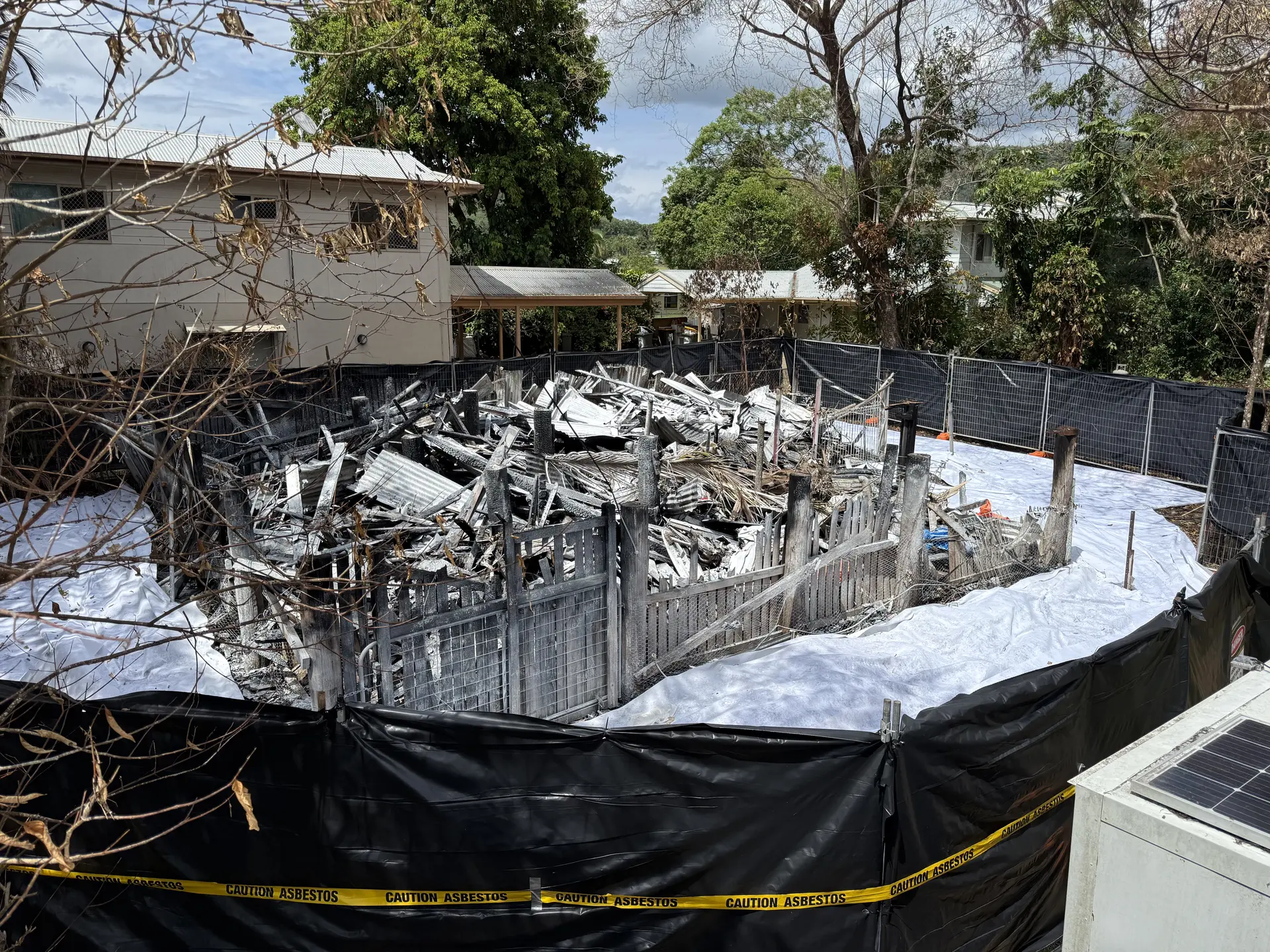
Damage turns bonded material friable. A roof that was stable sheeting on Monday is debris across a car park on Tuesday, and every vehicle that drives over it spreads it further. The window where a site can be contained cheaply is short.
Make-safe is about control, not completion. We secure the area, stop the spread and establish what is actually there, so that the removal, remediation or demolition that follows can be planned properly instead of guessed at.
Scope
What Make-Safe Covers
Typical emergency scopes on commercial, industrial and public-sector sites. If your situation is not listed, call and describe it.
- ·Site attendance and immediate hazard assessment
- ·Exclusion zones, barricading, signage and site security
- ·Suppression and binding of loose fibre and debris
- ·Recovery of accessible debris from access routes and hardstand
- ·Temporary sheeting, wrapping and weather protection
- ·Isolation of damaged services and plant where required
- ·Sampling and reporting where the material is unknown
- ·A written pathway to removal, remediation or demolition
Process
How a Make-Safe Runs
Take the call
We establish what has happened, what the building is likely to contain and what is immediately at risk, before anyone is committed to site.
Attend and assess
A supervisor attends, walks the perimeter and identifies where material has travelled, which is usually further than the damage itself.
Secure the perimeter
Exclusion zones, barricading and signage go up first, so the affected area stops growing while everything else is being worked out.
Suppress and stabilise
Loose material is wetted, bound or covered so wind and traffic stop moving it. Access routes are cleared first where the site must stay operational.
Establish what is there
Where the material is unknown we sample it and send it to a NATA-accredited laboratory, so the next stage is planned on fact rather than assumption.
Set the pathway
You receive a written position on what has to happen next, in what order, and what has to be notified, so insurers and certifiers can act on it.
Compliance
Working With Insurers and Certifiers
Documentation in the format the claim needs. Scope of works, methodology, monitoring results and clearance documentation, issued in the form loss adjusters ask for. Most claims stall on missing documentation rather than on the work itself.
Notification handled by us. Where the work is notifiable, Workplace Health and Safety Queensland is notified by us. Emergency circumstances change what is required, and that is assessed on the day rather than assumed.
Verification you can put in front of an adjuster. Air monitoring and clearance are part of what we deliver. On work we are removing ourselves, they are carried out by an independent licensed asbestos assessor or competent person we engage, which is exactly the separation an insurer looks for.
One contractor through to completion. The crew that secures the site is the crew that removes, remediates or demolishes, so nothing is lost in a handover between contractors.
Questions
Emergency Response Questions
What should I do before you arrive?
Keep people out of the affected area and off any debris, and do not sweep, hose or drive over it. Sweeping and pressure washing are the two actions that turn a contained incident into a spread one. Photograph what you can safely see from outside the area, because insurers will ask.
Is fire-damaged asbestos always a friable job?
Not always, but assume it until it is assessed. Heat and impact break the matrix that held the fibres, and material that was bonded before the event frequently is not afterwards. The condition of the material governs the controls, not the label it had originally.
Do you work directly with insurers?
Yes. We can deal with the insurer or the loss adjuster directly and issue documentation in the format they need. We can also work to a scope the insurer has already set, and tell you plainly where we think that scope is going to fall short.
Does make-safe commit us to using you for the removal?
No. Make-safe is a defined scope that stands on its own, and the written pathway you receive is yours to tender however you like. Most clients continue with us because the site is already known, but that is a decision you make afterwards.
The other half of the licence
Fire-Damaged Asbestos Demolition
Where the structure is beyond saving, demolition under the highest class of asbestos control.
We are set up for commercial, industrial and public-sector work, and that is where our plant and crews spend their time. We do take residential enquiries, and if you have asbestos on a house we will either help or tell you who should.
Not sure what you have?
Send through what you know and we will tell you what it looks like and what it would take.